0:00
Thermo Sudoku
Digits climb from the bulb. Free, at five levels.
How to play thermo sudoku
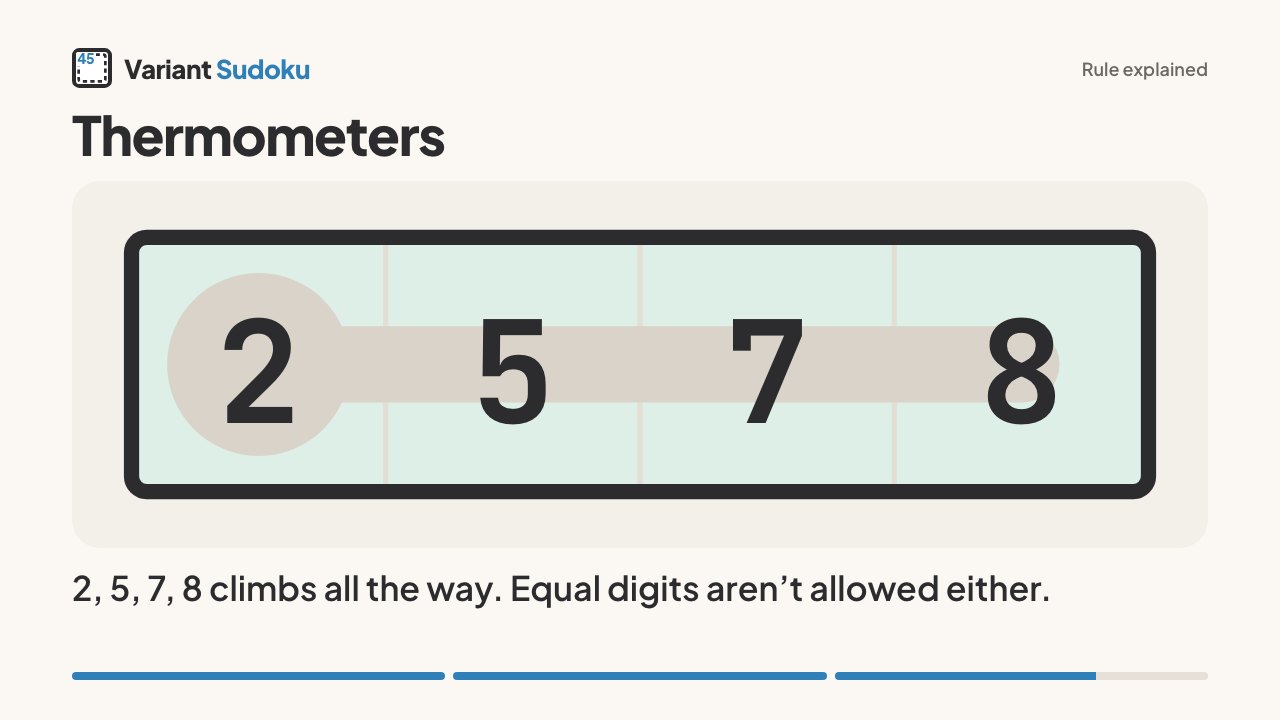
In thermo sudoku, grey thermometers run across the grid. Digits must strictly increase from the round bulb to the far end, so a long thermometer leaves each cell only a narrow range of digits.
Thermos are a good first variant: the rule is simple and the ranges do a lot of work early. Our puzzles are set so the thermometers matter from the first few moves.
At a glance
- Digits rise from the round bulb to the far tip.
- The bulb is the smallest digit on the thermo, the tip the largest.
- Digits never repeat along a thermo, since each is bigger than the last.
- Length sets each cell's range. A 9-cell thermo reads 1 to 9.
Thermometer ranges
The range of digits each cell can hold, by the thermo's length, before anything else is known. Cell 1 is the bulb. On a thermo of n cells, cell k is at least k and at most 9 − n + k.
| Length | Bulb | 2 | 3 | 4 | 5 | 6 | 7 | 8 | 9 |
|---|---|---|---|---|---|---|---|---|---|
| 2 | 1–8 | 2–9 | |||||||
| 3 | 1–7 | 2–8 | 3–9 | ||||||
| 4 | 1–6 | 2–7 | 3–8 | 4–9 | |||||
| 5 | 1–5 | 2–6 | 3–7 | 4–8 | 5–9 | ||||
| 6 | 1–4 | 2–5 | 3–6 | 4–7 | 5–8 | 6–9 | |||
| 7 | 1–3 | 2–4 | 3–5 | 4–6 | 5–7 | 6–8 | 7–9 | ||
| 8 | 1–2 | 2–3 | 3–4 | 4–5 | 5–6 | 6–7 | 7–8 | 8–9 | |
| 9 | 1 | 2 | 3 | 4 | 5 | 6 | 7 | 8 | 9 |
How to start a thermo sudoku
Write in the ranges
Count each cell's position from both ends. On a 6-cell thermo, the bulb is 1 to 4 and the tip 6 to 9. The range table has every length.
Start with the longest thermos
A 7-cell thermo leaves each cell three options and an 8-cell thermo two. Long thermos usually hold the break-in.
Split the thermo at a given
A given digit splits a thermo: everything before it is lower, everything after it higher. A 6 forces the next two cells into 7 to 9.
Pair up low and high ends
If two bulbs in one box can each only be 1 or 2, they're a pair, and no other cell in that box can be 1 or 2.
Re-check ranges as you go
Each candidate you remove can lift the floor or drop the ceiling of the cells further along. Thermometer logic chains down the whole line.
Common mistakes
Assuming digits are consecutive
Digits must rise, but they can skip. 1, 4, 9 is a fine three-cell thermo.
Reading from the wrong end
The bulb, the round end, is the smallest digit. The flat end is the largest.
Forgetting branches
When a thermo forks, every branch rises from the shared bulb. Two branches can repeat a digit only if those cells don't share a row, column or box.
Five levels, no guessing
Every puzzle has one solution, proved when it is set, and our solver finishes it by logic alone. The level is the hardest step the solve needs. Here is what each level asks of a thermo puzzle:
- EasyRanges from each thermo's length and from given digits, then singles.Play Easy
- MediumRanges that tighten as neighbors lose candidates, plus pointing pairs.Play Medium
- HardThermo ranges combined with naked and hidden pairs and triples.Play Hard
- ExpertX-Wings, Skyscrapers and wings on top of the thermos.Play Expert
- FiendishChains and coloring, and testing every way a thermo can be filled.Play Fiendish
The daily variant rotates through 11 kinds, so a thermo daily comes round about every 11 days. Past dailies
Hand-set thermo puzzles
Our levels are a good start. For more, Explore has 415 thermo puzzles made by people, from Logic Masters and Cracking the Cryptic. A few of the most popular:
 Nonconsecutive Spoonsby Phistomefel
 Blue Wavesby antiknight
 One Minute Puzzleby wuc
 Odd or Even Thermometersby Md88keys
 Thermotabby timotab
 Foggy Beginningby Imagine_Beno
 I Love You and Sudokuby Kirra
 Unusually Hotby marty_sears
Setters with the most thermo puzzles:
- meggen033 20
- Mr Toffee 11
- Skully571 10
- Brandy New 10
- Vythic 9
- gwai77 7
- starwarigami 7
- Marty Sears 6
- wuc 5
- lgastako 5
Often combined with:
- Thermo + Kropki 166
- Thermo + Killer 130
- Thermo + German Whispers 111
- Thermo + Arrow 92
- Thermo + Renban 75
- Thermo + Fog of War 62
- Thermo + XV 54
- Thermo + Region Sum Lines 43
- Thermo + X-Sums 36
- Thermo + Anti-Knight 29
All 415 thermo puzzles in Explore · Make your own thermo sudoku
Questions
Can digits repeat on a thermometer?
No. Each digit must be bigger than the one before it, so a thermometer never holds the same digit twice.
What does a long thermometer tell me?
A thermometer of 9 cells must be 1 to 9 in order. One of 8 cells leaves each cell two options. Count from both ends to get each cell's range.
What is the bulb?
The round end. It holds the smallest digit on the thermometer.
What range can each thermometer cell hold?
On a thermo of n cells, cell k (counting the bulb as 1) is at least k and at most 9 − n + k. On a 5-cell thermo the bulb is 1 to 5 and the tip 5 to 9.
Can a thermometer bend or cross boxes?
Yes. Thermos can turn corners, run diagonally and cross box borders. Only the order from bulb to tip matters.
Is thermo sudoku good for beginners?
It's one of the best first variants. The rule is easy to see and the ranges give you places to start. Our Easy thermos need nothing beyond ranges and singles.
More ways to play
Classic Sudoku1 to 9 in every row, column and boxKiller SudokuCages that add upArrow SudokuThe arrow sums to its circleKropki SudokuWhite dots, black dotsXV SudokuX is 10, V is 5Sandwich SudokuSum between the 1 and the 9German Whispers SudokuNeighbors differ by 5 or moreDiagonal SudokuBoth diagonals hold 1 to 9Anti-Knight SudokuNo repeat a knight's move apartAnti-King SudokuTouching cells never repeat