0:00
Sandwich Sudoku
Sum between the 1 and the 9. Free, at five levels.
How to play sandwich sudoku
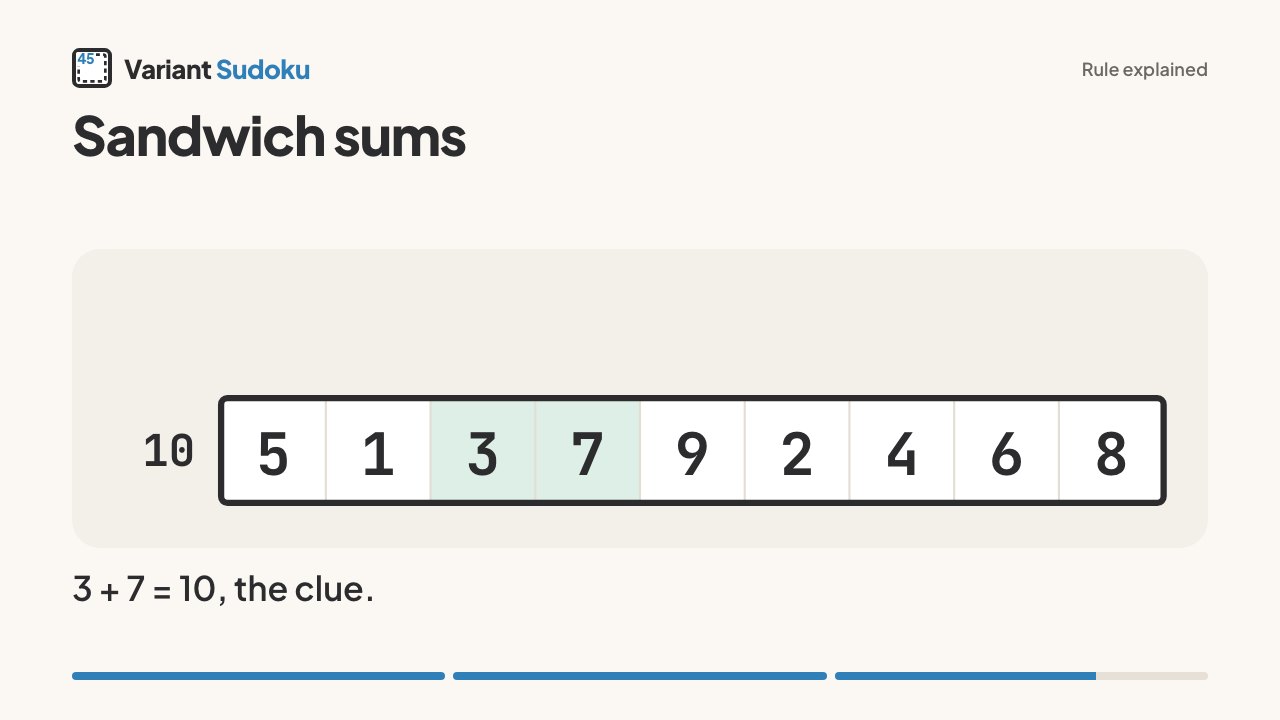
Sandwich sudoku puts numbers outside the grid. Each one is the sum of the digits between the 1 and the 9 in that row or column, the filling of the sandwich.
A clue of 0 means the 1 and 9 are next to each other, and a clue of 35 means they sit at the two ends. Most solves start by working out how far apart the 1 and 9 can be.
At a glance
- A clue outside the grid sums the digits between 1 and 9.
- 1 and 9 themselves don't count.
- A clue of 0 means 1 and 9 are next to each other.
- The biggest clue is 35, with 1 and 9 at the two ends.
Sandwich sums
Every sandwich total, how many cells can sit between 1 and 9, and which digits from 2 to 8 can make it. Totals with one combination are highlighted. Use the finder to filter by digits you already know.
Tap a digit once if it must be in, twice to leave it out
Every sandwich total 0 to 35
| Total | Cells between | Possible fillings |
|---|---|---|
| 0 | 0 | – |
| 1 | none | Impossible |
| 2 | 1 | 2 |
| 3 | 1 | 3 |
| 4 | 1 | 4 |
| 5 | 1, 2 | 5 23 |
| 6 | 1, 2 | 6 24 |
| 7 | 1, 2 | 7 25 34 |
| 8 | 1, 2 | 8 26 35 |
| 9 | 2, 3 | 27 36 45 234 |
| 10 | 2, 3 | 28 37 46 235 |
| 11 | 2, 3 | 38 47 56 236 245 |
| 12 | 2, 3 | 48 57 237 246 345 |
| 13 | 2, 3 | 58 67 238 247 256 346 |
| 14 | 2, 3, 4 | 68 248 257 347 356 2345 |
| 15 | 2, 3, 4 | 78 258 267 348 357 456 2346 |
| 16 | 3, 4 | 268 358 367 457 2347 2356 |
| 17 | 3, 4 | 278 368 458 467 2348 2357 2456 |
| 18 | 3, 4 | 378 468 567 2358 2367 2457 3456 |
| 19 | 3, 4 | 478 568 2368 2458 2467 3457 |
| 20 | 3, 4, 5 | 578 2378 2468 2567 3458 3467 23456 |
| 21 | 3, 4, 5 | 678 2478 2568 3468 3567 23457 |
| 22 | 4, 5 | 2578 3478 3568 4567 23458 23467 |
| 23 | 4, 5 | 2678 3578 4568 23468 23567 |
| 24 | 4, 5 | 3678 4578 23478 23568 24567 |
| 25 | 4, 5 | 4678 23578 24568 34567 |
| 26 | 4, 5 | 5678 23678 24578 34568 |
| 27 | 5, 6 | 24678 34578 234567 |
| 28 | 5, 6 | 25678 34678 234568 |
| 29 | 5, 6 | 35678 234578 |
| 30 | 5, 6 | 45678 234678 |
| 31 | 6 | 235678 |
| 32 | 6 | 245678 |
| 33 | 6 | 345678 |
| 34 | none | Impossible |
| 35 | 7 | 2345678 |
A dash means no filling: the 1 and 9 sit side by side. The gap between 1 and 9 is one more than the number of filling cells.
How to start a sandwich sudoku
Read the extreme clues
0 means 1 and 9 touch, and 35 means they're at the two ends with 2 to 8 between. 2, 3 and 4 can each only be one digit. The sums table shows every other total.
Count the gap
Each total allows only some sandwich lengths. A total of 5 is 5 alone or 2 + 3, so 1 and 9 are two or three cells apart.
Place 1 and 9 together
In each row and column, 1 and 9 are the bread. Where the gap is fixed, they can only sit in a few spots, and those spots interact with the columns.
Fill the filling
Once the bread is placed, the filling is a cage with a known total, so killer combinations take over. The killer combination chart helps.
Work rows and columns together
A 1 or 9 placed by a row clue is also bread for its column. Most sandwich solves bounce between the two.
Common mistakes
Counting 1 or 9 in the sum
Only the digits between them count, never the bread.
Fixing the order
The 1 can be on either side of the 9. The clue says nothing about which comes first.
Forgetting rows without clues
No clue means no information, not a sum of 0.
Five levels, no guessing
Every puzzle has one solution, proved when it is set, and our solver finishes it by logic alone. The level is the hardest step the solve needs. Here is what each level asks of a sandwich puzzle:
- EasyReading the clues that fix 1 and 9, then singles.Play Easy
- MediumWhere 1 and 9 can sit for each clue, plus pointing pairs.Play Medium
- HardWhat the filling can contain, with pairs and triples.Play Hard
- ExpertX-Wings, Skyscrapers and wings on top of the sandwiches.Play Expert
- FiendishChains and coloring, and testing every placement of the bread.Play Fiendish
The daily variant rotates through 11 kinds, so a sandwich daily comes round about every 11 days. Past dailies
Hand-set sandwich puzzles
Our levels are a good start. For more, Explore has 78 sandwich puzzles made by people, from Logic Masters and Cracking the Cryptic. A few of the most popular:
 Sandwichby burgermason
 Coloured sudoku #4by Sudonym
 Vol.7 Sandwich #116by Adrian Klausen
 Ponzi's Sandwich Shop (Dazed Out #7)by .proxz14
 Skysandoku 2by GiAnMMV
 Brave Little Toastby Jorava
 Sand-sandwich-wichesby RockyRoer
 Medusa's Lairby XeonRisq
Setters with the most sandwich puzzles:
- aqjhs 5
- yttrio 3
- Lizzy01 3
- .proxz14 3
- GiAnMMV 3
- Sudonym 2
- Adrian Klausen 2
- Chip Sounder 2
- burgermason 1
- Lorena 1
Often combined with:
- Sandwich + Killer 25
- Sandwich + Kropki 22
- Sandwich + Arrow 18
- Sandwich + X-Sums 14
- Sandwich + German Whispers 13
- Sandwich + Thermo 12
- Sandwich + Skyscraper 12
- Sandwich + Irregular 10
- Sandwich + Modifier Cells 9
- Sandwich + Little Killer 8
All 78 sandwich puzzles in Explore · Make your own sandwich sudoku
Questions
What does a sandwich clue of 0 mean?
The 1 and 9 are next to each other, with nothing between them.
What is the biggest sandwich clue?
35: everything from 2 to 8, which means the 1 and 9 are at opposite ends of the row or column.
Do the 1 and 9 count in the sum?
No. Only the digits between them count.
What sandwich totals are impossible?
Only 1 and 34. The filling comes from 2 to 8, so nothing makes 1, and 34 would need every digit from 2 to 8 except one worth 1.
Which sandwich totals have only one combination?
0, 2, 3 and 4 (no filling, or a single 2, 3 or 4), and 31, 32, 33 and 35. The sums table on this page highlights each one.
Which clues are for rows and which for columns?
Clues to the left or right of the grid are for rows, and clues above or below are for columns.
More ways to play
Classic Sudoku1 to 9 in every row, column and boxKiller SudokuCages that add upThermo SudokuDigits climb from the bulbArrow SudokuThe arrow sums to its circleKropki SudokuWhite dots, black dotsXV SudokuX is 10, V is 5German Whispers SudokuNeighbors differ by 5 or moreDiagonal SudokuBoth diagonals hold 1 to 9Anti-Knight SudokuNo repeat a knight's move apartAnti-King SudokuTouching cells never repeat