0:00
Kropki Sudoku
White dots, black dots. Free, at five levels.
How to play kropki sudoku
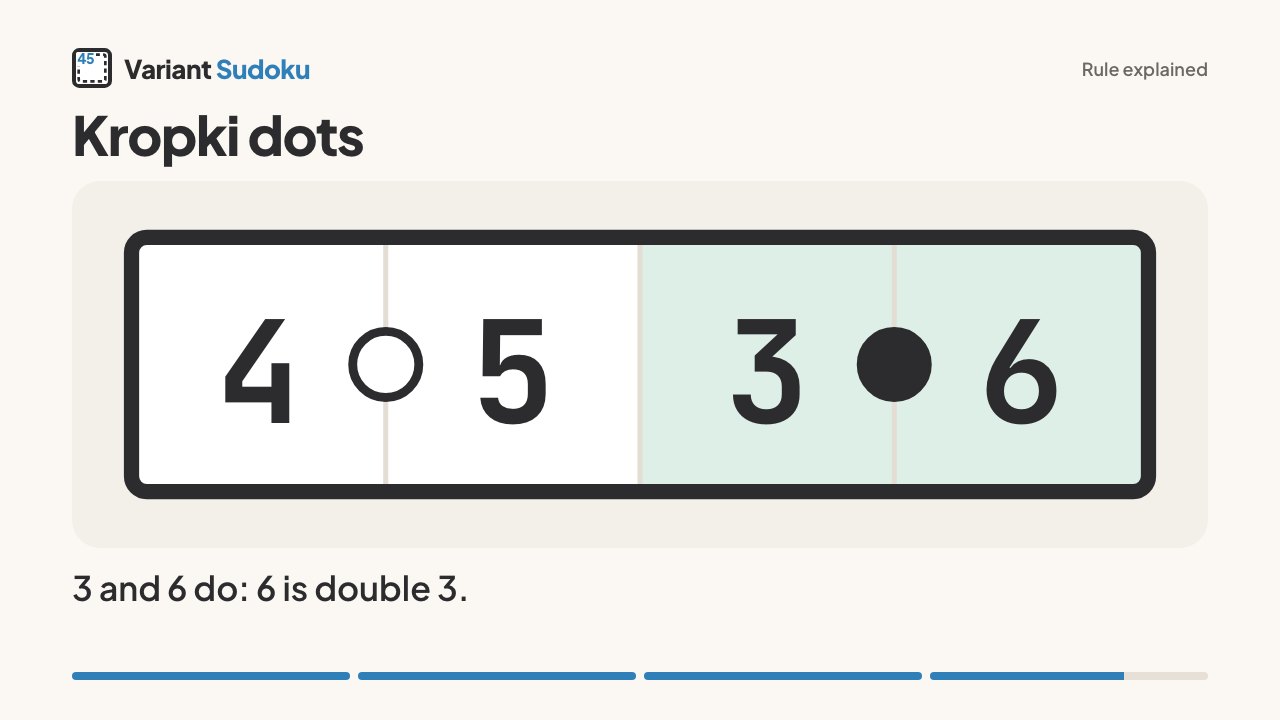
Kropki sudoku puts dots between neighboring cells. A white dot means the two digits are consecutive, like 4 and 5. A black dot means one digit is double the other, like 3 and 6. A 1 and 2 could take either dot.
Black dots are the strongest clue: only 1, 2, 3, 4, 6 and 8 can sit on one, so 5, 7 and 9 never do. Some of our puzzles also use the negative rule, where a missing dot is a clue too.
At a glance
- A white dot joins two consecutive digits, like 4 and 5.
- A black dot joins a digit and its double, like 3 and 6.
- 1 and 2 fit either dot.
- 5, 7 and 9 can never sit on a black dot.
Kropki dot chart
Every digit and what it can sit next to across each kind of dot. The black-dot column is the one to learn: it's short, and it decides most kropki break-ins.
| Digit | White dot (consecutive) | Black dot (double) |
|---|---|---|
| 1 | 123456789 | 123456789 |
| 2 | 123456789 | 123456789 |
| 3 | 123456789 | 123456789 |
| 4 | 123456789 | 123456789 |
| 5 | 123456789 | 123456789none |
| 6 | 123456789 | 123456789 |
| 7 | 123456789 | 123456789none |
| 8 | 123456789 | 123456789 |
| 9 | 123456789 | 123456789none |
Black-dot pairs: 1-2, 2-4, 3-6, 4-8. Two black dots in a straight line: 1-2-4 or 2-4-8. 1-2 is the only pair that fits both dots.
How to start a kropki sudoku
Clear 5, 7 and 9 off black dots
Their doubles are too big and their halves aren't whole. That leaves 1, 2, 3, 4, 6 and 8 on every black dot.
Solve black-dot chains
Two black dots in a straight line make a three-cell chain that can only be 1-2-4 or 2-4-8, with 2 or 4 in the middle. So the middle cell is 2 or 4 straight away.
Count white-dot runs
Three white dots in a straight line are four consecutive digits in order, like 3-4-5-6, so the two middle cells can't be 1 or 9. A run of five always contains a 5.
Use the negative rule
When all dots are given, neighbors without a dot are neither consecutive nor double. That often clears more candidates than the dots themselves. The kropki dots lesson practices it.
Watch 1 and 2
They're the only pair that fits both dots, so a dot that could be either color often hides a 1-2 pair.
Common mistakes
Treating a white dot as 'one more'
Consecutive works in either direction: a 6 next to a white dot could have a 5 or a 7 on the other side.
Forgetting a dot can be 1 and 2
1 and 2 are consecutive and one is double the other, so either color of dot can hold them.
Applying the negative rule when it isn't there
Only puzzles that say all dots are given use it. Check the rules panel.
Five levels, no guessing
Every puzzle has one solution, proved when it is set, and our solver finishes it by logic alone. The level is the hardest step the solve needs. Here is what each level asks of a kropki puzzle:
- EasyClearing digits that can't sit on a dot, then singles.Play Easy
- MediumTwo-cell dot logic: the pairs each dot allows, plus pointing pairs.Play Medium
- HardDot chains and the negative rule, with pairs and triples.Play Hard
- ExpertX-Wings, Skyscrapers and wings on top of the dots.Play Expert
- FiendishChains and coloring, and testing every way a line of dots can be filled.Play Fiendish
The daily variant rotates through 11 kinds, so a kropki daily comes round about every 11 days. Past dailies
Hand-set kropki puzzles
Our levels are a good start. For more, Explore has 948 kropki puzzles made by people, from Logic Masters and Cracking the Cryptic. A few of the most popular:
 RAT RUN 3: Double Dutchby marty_sears
 Crustby fuxia
 The Jugglerby H.Bell
 One Minute Puzzleby wuc
 Earth, Wind and Fire Speed Runby Will Power
 Just Kropkisby Hugo-Bob
 Midnight snackby gUBBLOR
 First Advent Sunday (Nala’s Advent(ures) Calendar 2023)by SandraNala
Setters with the most kropki puzzles:
- meggen033 97
- gwai77 27
- Will Power 26
- NotSoMagnifique 26
- lgastako 25
- Marty Sears 16
- pagedo 16
- GiAnMMV 15
- gUBBLOR 14
- Sudonym 14
Often combined with:
- Kropki + Killer 347
- Kropki + German Whispers 314
- Kropki + Renban 228
- Kropki + Fog of War 214
- Kropki + XV 182
- Kropki + Arrow 177
- Kropki + Thermo 166
- Kropki + Region Sum Lines 109
- Kropki + X-Sums 98
- Kropki + Ratio 70
All 948 kropki puzzles in Explore · Make your own kropki sudoku
Questions
What is the negative constraint in kropki?
When a puzzle says all dots are given, two neighbors without a dot are neither consecutive nor one double the other. The rules on each puzzle say whether it applies.
Which digits can't go on a black dot?
5, 7 and 9. Their doubles are too big and their halves aren't whole numbers.
What does a chain of dots tell me?
Three white dots in a straight line are four consecutive digits in order. Two black dots in a straight line can only be 1-2-4 or 2-4-8, with 2 or 4 in the middle.
Which pairs can go on a black dot?
Only four: 1 and 2, 2 and 4, 3 and 6, 4 and 8.
What does kropki mean?
Kropki is Polish for dots. The puzzle is also called dots sudoku or consecutive and double sudoku.
Where can I learn kropki logic?
The kropki rules lesson explains the dots, and the kropki dots technique lesson has practice boards with chains and the negative rule.
More ways to play
Classic Sudoku1 to 9 in every row, column and boxKiller SudokuCages that add upThermo SudokuDigits climb from the bulbArrow SudokuThe arrow sums to its circleXV SudokuX is 10, V is 5Sandwich SudokuSum between the 1 and the 9German Whispers SudokuNeighbors differ by 5 or moreDiagonal SudokuBoth diagonals hold 1 to 9Anti-Knight SudokuNo repeat a knight's move apartAnti-King SudokuTouching cells never repeat