0:00
Diagonal Sudoku
Both diagonals hold 1 to 9. Free, at five levels.
How to play diagonal sudoku
Diagonal sudoku, also called sudoku X, adds the two long diagonals as extra houses. Each diagonal must hold 1 to 9 once, just like a row, a column or a box.
The center cell is on both diagonals, and every diagonal cell sees more of the grid than usual. Our puzzles are set so the diagonals are needed to finish.
At a glance
- Both long diagonals hold 1 to 9 once.
- The center cell sits on both diagonals.
- Each diagonal crosses three boxes.
- Also called sudoku X or X-sudoku.
How the diagonals work
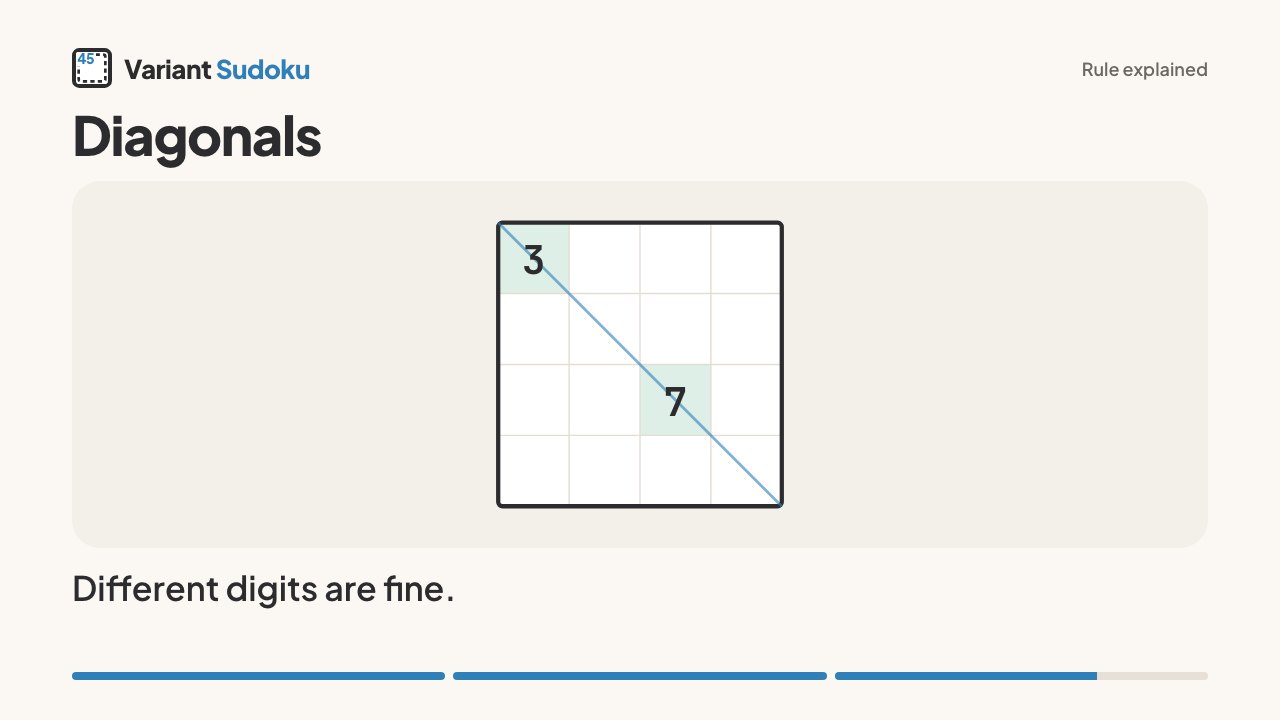
The two shaded lines are extra houses. Each one crosses three boxes and shares the center cell, so a digit on one diagonal rules out more of the grid than usual.
- A diagonal: 1 to 9 once
- r5c5, on both diagonals
How to start a diagonal sudoku
Scan the diagonals like a row
Each diagonal is a ninth house. Check which digits it's missing and where they can go, just like a row.
Watch the center cell
r5c5 is on both diagonals, its row, its column and the middle box: five houses. It's often one of the first cells to fall.
Use the corners of each box
In boxes 1, 3, 7 and 9, three cells lie on a diagonal. In box 5, five do. A digit placed on a diagonal clears those cells in other boxes.
Pointing pairs along the diagonal
If a box's candidates for a digit all lie on a diagonal, that digit comes off the rest of the diagonal. It's a pointing pair with a new kind of line.
Fall back on classic technique
Diagonal sudoku is classic sudoku with two more houses, so every classic technique still applies.
Common mistakes
Forgetting the second diagonal
There are two, top-left to bottom-right and top-right to bottom-left. Check both.
Treating short diagonals as houses
Only the two long, nine-cell diagonals count.
Missing the center's double duty
A digit in r5c5 is on both diagonals at once.
Five levels, no guessing
Every puzzle has one solution, proved when it is set, and our solver finishes it by logic alone. The level is the hardest step the solve needs. Here is what each level asks of a diagonal puzzle:
- EasySingles, with the diagonals as two more houses.Play Easy
- MediumPointing pairs and box/line reductions, including along the diagonals.Play Medium
- HardNaked and hidden pairs and triples.Play Hard
- ExpertX-Wings, Skyscrapers and wings.Play Expert
- FiendishColoring and chains. Never a guess.Play Fiendish
The daily variant rotates through 11 kinds, so a diagonal daily comes round about every 11 days. Past dailies
Hand-set diagonal puzzles
Our levels are a good start. For more, Explore has 61 diagonal puzzles made by people, from Logic Masters and Cracking the Cryptic. A few of the most popular:
 Modular Miracleby masetab
 Schubladenby Myxo
 2026 Killerby Florian Wortmann
 Quality Streetby Jay Dyer
 Follow-on Arrowsby Aad van de Wetering
 Diagonalityby The Book Wyrm
 San Joséby ICHTUES
 Major Diagonals Speed Runby Will Power
Setters with the most diagonal puzzles:
- gwai77 4
- Florian Wortmann 3
- Merdock 3
- pagedo 2
- Aad van de Wetering 2
- ICHTUES 2
- Will Power 1
- PhoenixAki 1
- Gerhard1963 1
- Blobz 1
Often combined with:
- Diagonal + Kropki 24
- Diagonal + Killer 18
- Diagonal + German Whispers 16
- Diagonal + Renban 14
- Diagonal + Arrow 11
- Diagonal + XV 10
- Diagonal + Thermo 8
- Diagonal + Odd/Even 8
- Diagonal + Fog of War 7
- Diagonal + Region Sum Lines 5
All 61 diagonal puzzles in Explore · Make your own diagonal sudoku
Questions
Is diagonal sudoku the same as sudoku X?
Yes. Both names mean a sudoku where the two main diagonals also hold 1 to 9 once.
Does every cell on the diagonal count?
Yes, all nine cells of each long diagonal, including the shared center cell.
Is it harder than classic sudoku?
It usually has fewer givens, but the diagonals add more ways to find singles. The level shown on each puzzle is the true guide.
How many houses does a diagonal sudoku have?
29: nine rows, nine columns, nine boxes and two diagonals.
Which cells are on a diagonal?
r1c1, r2c2 to r9c9 on one, and r1c9, r2c8 to r9c1 on the other. r5c5 is on both, so 17 cells in all.
More ways to play
Classic Sudoku1 to 9 in every row, column and boxKiller SudokuCages that add upThermo SudokuDigits climb from the bulbArrow SudokuThe arrow sums to its circleKropki SudokuWhite dots, black dotsXV SudokuX is 10, V is 5Sandwich SudokuSum between the 1 and the 9German Whispers SudokuNeighbors differ by 5 or moreAnti-Knight SudokuNo repeat a knight's move apartAnti-King SudokuTouching cells never repeat