0:00
Anti-Knight Sudoku
No repeat a knight's move apart. Free, at five levels.
How to play anti-knight sudoku
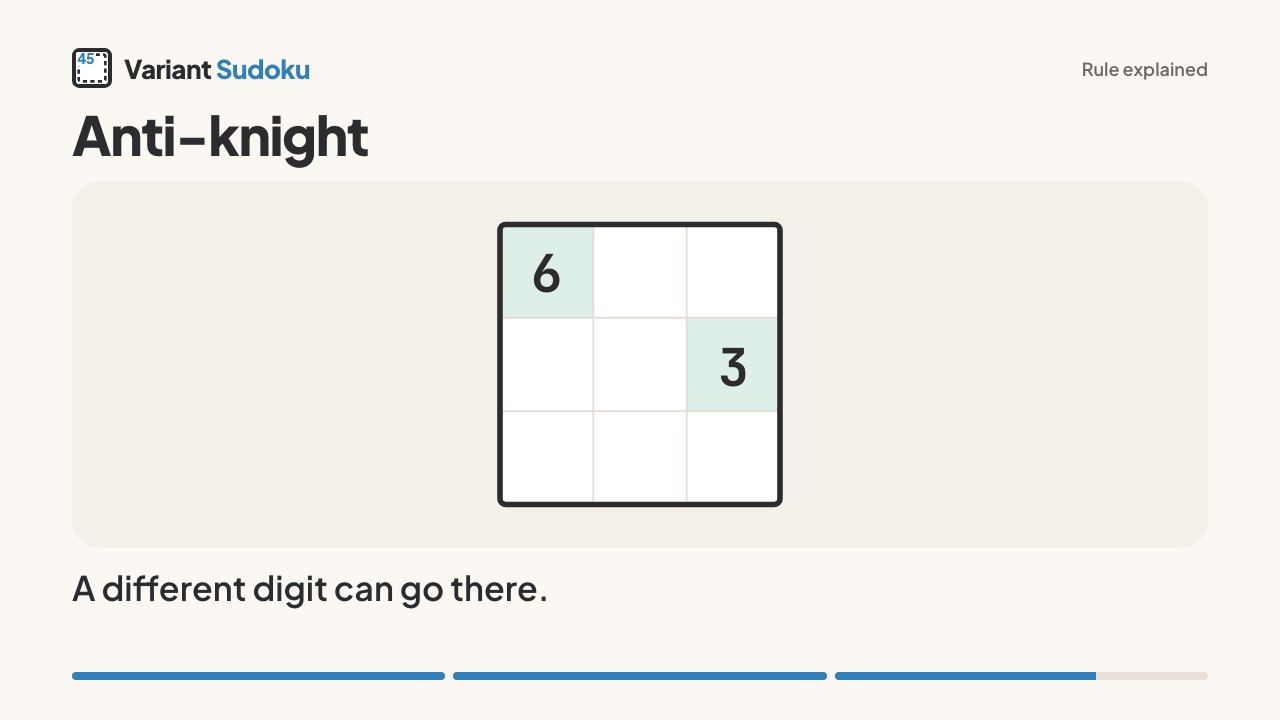
In anti-knight sudoku, two cells a chess knight's move apart (two steps one way, one step the other) can't hold the same digit. Each cell sees up to eight extra cells.
Inside a box the rule adds nothing, because the box already bans repeats. It bites across box borders, where it shapes how each digit can move through a band of three boxes. Our puzzles are set so the knight's moves are needed to finish.
At a glance
- Cells a knight's move apart can't repeat a digit.
- A cell in the middle of the grid has eight knight's moves.
- The rule only adds anything across box borders.
- Every classic technique still works; the knight only adds eliminations.
The knight's move
The marked cells are a knight's move from the 5. None of them can be 5. The ones in the 5's own box were already ruled out by the box, so the new information is in the boxes around it.
- New: can't be 5 because of the knight
- Already ruled out by the box
How to start an anti-knight sudoku
Scan with the knight
For each placed digit, cross it off the cells a knight's move away. It's like cross-hatching with an extra pattern.
Look at neighboring boxes
A digit in one box removes up to two cells in each box beside it, on top of the row or column it already rules out. Often that leaves one spot.
Check the corners of the grid
Corner cells have only two knight's moves, but they combine with rows and columns at the edges.
Use pairs
If a digit can only be in two cells of a box, every cell a knight's move from both of them can't be that digit.
Mind the givens
Anti-knight puzzles often start with very few givens. Every one is a source of eliminations.
Common mistakes
Forgetting the short leg
A knight moves two then one, in any of eight directions. It's easy to check four and miss four.
Applying it to empty cells
The rule only rules out a digit once it's placed, or when every option for it lands on the same cell.
Mixing it up with anti-king
Anti-king bans touching cells. Anti-knight bans the L-shaped jump.
Five levels, no guessing
Every puzzle has one solution, proved when it is set, and our solver finishes it by logic alone. The level is the hardest step the solve needs. Here is what each level asks of a anti-knight puzzle:
- EasySingles, counting knight's moves as extra eliminations.Play Easy
- MediumPointing pairs and box/line reductions.Play Medium
- HardNaked and hidden pairs and triples.Play Hard
- ExpertX-Wings, Skyscrapers and wings.Play Expert
- FiendishColoring and chains. Never a guess.Play Fiendish
The daily variant rotates through 11 kinds, so a anti-knight daily comes round about every 11 days. Past dailies
Hand-set anti-knight puzzles
Our levels are a good start. For more, Explore has 172 anti-knight puzzles made by people, from Logic Masters and Cracking the Cryptic. A few of the most popular:
 One Killer Knightby meggen033
 Counted Knightsby Scojo
 Ascension (Antiknight Arrows)by Florian Wortmann
 Knights on the Beachby Apricot
 Coincidenceby Joanie
 Irish Whispersby JKBongos
 2 Crosses (Antiknight Sudoku)by Yoshi Baroshi
 The knight and the bishopby Ollos
Setters with the most anti-knight puzzles:
- meggen033 31
- Vitray 8
- gwai77 5
- Villse 4
- Daniel Hanson 4
- Florian Wortmann 3
- addie 3
- iEtsh 3
- Aad van de Wetering 3
- billybeth 2
Often combined with:
- Anti-Knight + Killer 70
- Anti-Knight + Kropki 58
- Anti-Knight + Arrow 35
- Anti-Knight + Fog of War 29
- Anti-Knight + Thermo 29
- Anti-Knight + Renban 28
- Anti-Knight + XV 26
- Anti-Knight + German Whispers 25
- Anti-Knight + Anti-King 19
- Anti-Knight + Region Sum Lines 12
All 172 anti-knight puzzles in Explore · Make your own anti-knight sudoku
Questions
What is a knight's move in sudoku?
Two cells in one direction and one cell sideways, the L-shape a chess knight moves in.
Does the anti-knight rule cross box borders?
Yes. It applies everywhere in the grid, inside boxes and across them.
Is anti-knight sudoku harder?
It needs fewer givens and makes you look further, but the logic is the same scanning you use in classic sudoku.
How many cells does a knight's move rule out?
Up to eight. Cells near the edge have fewer: a corner cell has two.
Can anti-knight be combined with other rules?
Often. With anti-king and a non-consecutive rule it makes the miracle sudoku family, and hand-set puzzles mix it with thermos, killers and more. Explore lists them.
More ways to play
Classic Sudoku1 to 9 in every row, column and boxKiller SudokuCages that add upThermo SudokuDigits climb from the bulbArrow SudokuThe arrow sums to its circleKropki SudokuWhite dots, black dotsXV SudokuX is 10, V is 5Sandwich SudokuSum between the 1 and the 9German Whispers SudokuNeighbors differ by 5 or moreDiagonal SudokuBoth diagonals hold 1 to 9Anti-King SudokuTouching cells never repeat