0:00
Arrow Sudoku
The arrow sums to its circle. Free, at five levels.
How to play arrow sudoku
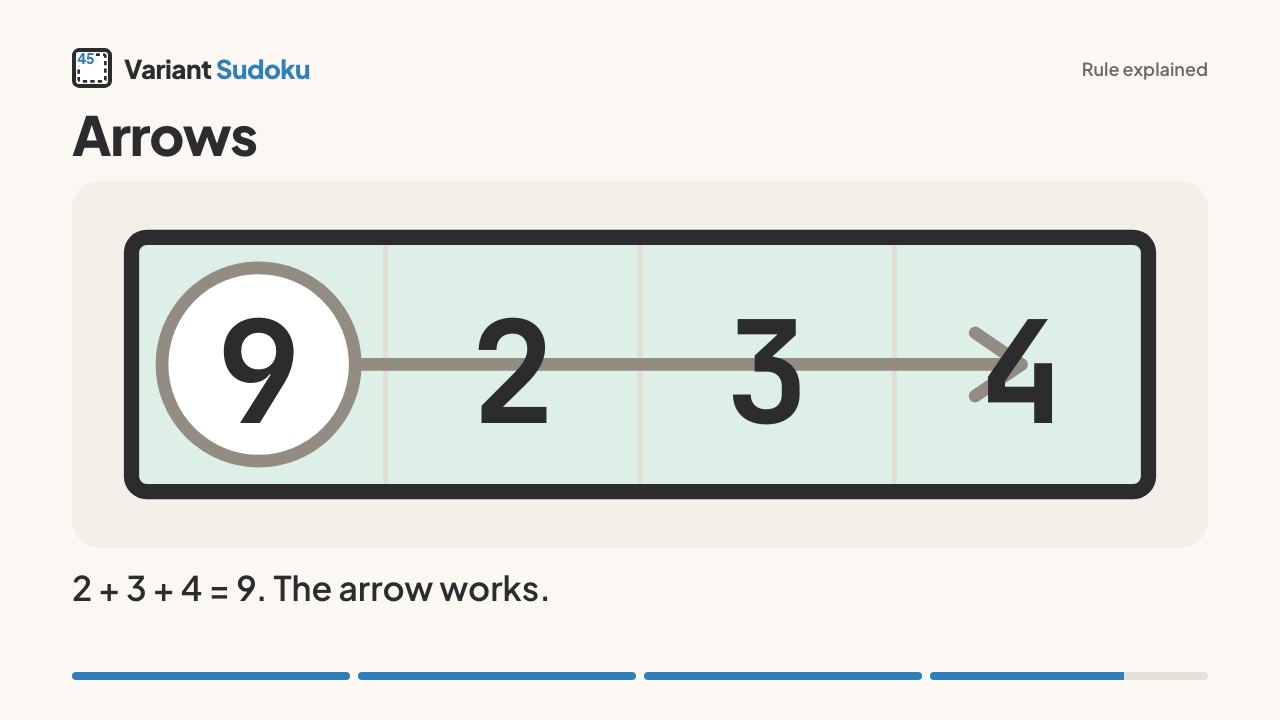
Arrow sudoku adds circles with arrows coming out of them. The digits along an arrow add up to the digit in its circle. Digits may repeat along an arrow when the cells don't share a row, column or box.
A circle holds at most 9, so arrows are short on room: three arrow cells that share a box total at least 6, leaving the circle 6 to 9. Our puzzles are set so the arrow sums open the grid.
At a glance
- Digits on the arrow add up to the digit in its circle.
- The circle is at least as big as any digit on its arrow.
- Arrow digits can repeat if the cells don't share a row, column or box.
- On a two-cell arrow in one house, the circle is at least 3.
Arrow sums
What the shaft can hold for each circle digit. The first table covers two-cell arrows, the second three-cell arrows whose cells all share a row, column or box (so no digit repeats).
Two-cell arrows
| Circle | Different digits | Same digit twice (only if the cells share no house) |
|---|---|---|
| 2 | – | 11 |
| 3 | 12 | – |
| 4 | 13 | 22 |
| 5 | 14 23 | – |
| 6 | 15 24 | 33 |
| 7 | 16 25 34 | – |
| 8 | 17 26 35 | 44 |
| 9 | 18 27 36 45 | – |
Three-cell arrows in one house
| Circle | Arrow digits |
|---|---|
| 6 | 123 |
| 7 | 124 |
| 8 | 125 134 |
| 9 | 126 135 234 |
Three different digits total at least 6, so the circle is 6 to 9. A four-cell arrow in one house totals at least 10, too much for a one-cell circle, so its cells must spread over more than one house.
How to start an arrow sudoku
Bound the circles
A circle is at least the smallest total its arrow can make. A three-cell arrow inside one box is at least 1 + 2 + 3 = 6, so its circle is 6, 7, 8 or 9.
Cap the shaft
The circle is at most 9, so each arrow cell is at most 9 minus the smallest the rest of the arrow can be. On a three-cell arrow in one box, no cell can be more than 6.
Use the circle's house
On an arrow of two or more cells, the circle is bigger than every arrow digit, so a low circle rules out high arrow digits and the reverse. If its box already has 8 and 9, the circle is at most 7.
Pair a long arrow with the 45 rule
Several arrows in one box share its 45. Arrows that run end to end through a row can set up the same adding-up logic as a killer. The arrows lesson shows how.
Look for the one-way totals
A circle 3 on a two-cell arrow in one house is 1 + 2. A circle 6 on a three-cell arrow in one house is 1 + 2 + 3. The arrow sums tables list the rest.
Common mistakes
Ruling out repeats too early
Arrow cells in different rows, columns and boxes can repeat. A bent arrow can hold 2, 1, 2.
Forgetting the circle is a cell too
The circle follows normal sudoku rules, so it can't repeat a digit already in its row, column or box.
Mixing up the pill
In hand-set puzzles, a circle stretched over two cells is a two-digit number. Our own arrow puzzles always use one-cell circles.
Five levels, no guessing
Every puzzle has one solution, proved when it is set, and our solver finishes it by logic alone. The level is the hardest step the solve needs. Here is what each level asks of a arrow puzzle:
- EasyArrow ranges from their length, then singles.Play Easy
- MediumArrow sum bounds and pointing pairs.Play Medium
- HardArrow sums with the no-repeat rule, pairs and triples.Play Hard
- ExpertX-Wings, Skyscrapers and wings on top of the arrows.Play Expert
- FiendishChains and coloring, and testing every way an arrow can be filled.Play Fiendish
The daily variant rotates through 11 kinds, so a arrow daily comes round about every 11 days. Past dailies
Hand-set arrow puzzles
Our levels are a good start. For more, Explore has 580 arrow puzzles made by people, from Logic Masters and Cracking the Cryptic. A few of the most popular:
 RAT RUN 4: Borderlineby marty_sears
 Cold Snapby SneakySteve
 Minchen's Boxby Gerhard1963
 Ascents Traversed Evenlyby Kaktuslav
 Sudoku Variants Series (003) - Search Nine Sudokuby Richard
 Product Pairrowby Calump
 Kick-startby Will Power
 Unwrapping (Nala‘s Adventures #24)by SandraNala
Setters with the most arrow puzzles:
- meggen033 29
- Marty Sears 27
- Mad-Tyas 13
- gwai77 11
- Vythic 11
- aqjhs 10
- Tessarin 10
- juggler 9
- Kaktuslav 8
- sujoyku 8
Often combined with:
- Arrow + Killer 178
- Arrow + Kropki 177
- Arrow + German Whispers 123
- Arrow + Thermo 92
- Arrow + Renban 90
- Arrow + Fog of War 84
- Arrow + XV 72
- Arrow + Irregular 68
- Arrow + Region Sum Lines 51
- Arrow + X-Sums 41
All 580 arrow puzzles in Explore · Make your own arrow sudoku
Questions
Can digits repeat on a sudoku arrow?
Yes, unless the cells share a row, column or box. Arrows that bend across boxes sometimes repeat a digit.
What can go in the circle?
Any digit from the smallest total its arrow can make up to 9. A two-cell arrow in one house needs at least 3, and a three-cell arrow in one house at least 6. If the arrow's cells can repeat, the floor is lower.
What if the circle covers two cells?
Some hand-set puzzles use a two-cell pill, read as a two-digit number such as 12. Our own arrow puzzles use one-cell circles.
Can a circle have more than one arrow?
Yes. Each arrow from the same circle sums to it separately, so two arrows from a circle 9 might be 4 + 5 and 1 + 8.
How is arrow sudoku different from killer?
Both are about sums, but a killer total is printed, while an arrow's total is a digit you have to find. That makes arrows a two-way puzzle: the shaft limits the circle and the circle limits the shaft.
Where can I practice arrow logic?
The arrow rules lesson explains the rule, and the arrows technique lesson has practice boards with worked steps.
More ways to play
Classic Sudoku1 to 9 in every row, column and boxKiller SudokuCages that add upThermo SudokuDigits climb from the bulbKropki SudokuWhite dots, black dotsXV SudokuX is 10, V is 5Sandwich SudokuSum between the 1 and the 9German Whispers SudokuNeighbors differ by 5 or moreDiagonal SudokuBoth diagonals hold 1 to 9Anti-Knight SudokuNo repeat a knight's move apartAnti-King SudokuTouching cells never repeat